
|
Join the campaign against military bases |
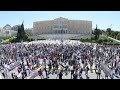
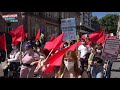
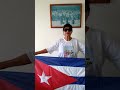
The Regional Office for Latin America of World Federation of Trade Unions denounces the increasing US military presence in Latin America (as well as in other parts of the world) and appeals to join the campaign to make LATIN AMERICA AND THE CARIBBEAN A REGION OF PEACE. The WFTU supports demands to dismantle all foreign military bases. Follow the link to read the call and explanatory memorandum [in Spanish]. Send support messages, records of actions and pictures to:
This email address is being protected from spam bots, you need Javascript enabled to view it
|
|
|
Interview with Professor Toshikazu Nagayama from Japan |

Professor Toshikazu Nagayama, Director of the Construction Industry’s Research Institute interviewed by Rober Brun with the help of an interpreter
Q: You have said that the wave of speculation changed the construction industry from top to bottom. Could you illustrate this upheaval?
A: There are two reasons behind it. Firstly, most people have neither the wealth nor earn enough money to buy a home and so they resort to borrowing. Their loans are dependent on the interbank market, the cost of housing is dictated by interbank lending rates, and as the loans are very high-risk, given the borrowers’ reduced means, they are also extremely profitable. Secondly, large commercial buildings, offices, etc. are also financed by the banking system through the same method of transforming bank credits into bonds negotiable on the stock exchange – the so-called securitization. This system has created both massive profits and huge losses. In the construction industry, the developers have been the means through which the banking system operates, and subcontracting has expanded in order to cut costs.
Q: You have also proposed a re-think of our industry’s policies for the future. In what way do you see this?
A: Governments should be the ones to invest in construction so as to limit speculation. Buildings could be sold with government help and a housing right should be installed facilitating access to housing and guaranteeing occupancy. Buildings endure and therefore have a long-term effect on the economic cycle. They therefore represent an element for development that can also be a stabilizing factor for both jobs and construction workers’ social conditions.
|
|
|
Interview with constructor Assane Diop from Senegal |

Assane Diop, general secretary of the National Union of Workers in Civil Engineering, Housing and Construction, SNTPBHC (UTS) on tour visiting work sites in Senegal
Q: Tell us about your work in Senegal
A: Our trade union centres fall into two groups: one of 4 organizations, the oldest and most militant, which includes my union, and one united front of 16 organizations. Every May Day the unions present their demands to the President of the Republic. We noted several similarities among the 22 points presented by the various unions and so we suggested to form a single trade union front to advance our most important demands: for instance, the situation of day labourers, transport problems, a reduction in the cost of vital foodstuffs and services (water, electricity, telephone), an overall wage rise, a reduction in rents, lower taxation on wages, better retirement pensions and a relaunch of companies in difficulty.
|
|
Read more...
|
|
|
Interview with pipefitter Bill Signal from Canada |

Bill Signal, United Association of Plumbers and Steamfitters of Toronto
Q. Can you explain how your pension system functions?
R. We the Toronto Pipefitters have two types of pension schemes:
A defined contribution scheme, which means that a separate account is established for each member and when the person retires he receives an amount corresponding to the accumulated investment income that he has earned over the many years of work. The plan invests 60 percent of the money in stock investments and the remaining 40 percent in government bonds. Three times each year the member receives a statement as to his employers contributions along with what the investments have earned.
|
|
Read more...
|
|
|
Interview with constructor Marc Pognon from Martinique |

In the middle, Marc Pognon, CGTM-WFTU, from Martinique, sharing a beer in Tokyo with Robert Brun and the Japanese-French interpreter
Q. Martinique, a French overseas department in the West Indies, was shaken by a potent strike movement in February 2009. Can you tell us about the causes?
A. Our union was one of the triggers of the movement, whose origin is quite simple: the young generation have grown aware that things can’t go on as they are. In Martinique the cost of living is higher than in France itself, unemployment is also greater, and the exploitation by the ruling class – the settlers – is getting ever more unbearable. Overall the people supported the movement, and it took a general strike of over a month to force the French government to introduce a temporary cut in the price of fuel and a 200-euro wage rise. In any case, as in other countries, further struggles will be necessary against exploitation and to strengthen our rights to autonomy.
|
|
|
Interview with constructor Anders Olesen from Denmark |

Anders Olesen, president of the Copenhagen Association of Building Trades in Tokyo
Q. Your union represents ALL those who work in the construction industry in Denmark. How did you decide to include all and everyone?
A. With the enlargement of Europe in 2004, we already had experience with migrant workers every time we contacted workers and then employers to ensure that migrant workers had the same rights as Danes. The differences between wages and benefits increased tenfold when the borders were opened. We decided to follow our original approach and consider that every worker was welcome. We campaign together with them for the same rights for all. We have never regretted this stance. We demand that migrant workers receive vocational and civil training, have regulations applied to sub-contracting and have their rights covered by legislation, particularly concerning social security and housing. They pay taxes, so they should have the same rights as Danish workers.
At present we are concerned about the recent decisions of the European Court of Justice on the right to competition that would take precedence over social and trade union rights. Together with other European unions we want to make sure that social and trade union rights are inalienable.
|
|
|
Interview with constructor Juan Carlos Salas from Panama |

Juan Carlos Salas, SUNTRACS, Panama
Q. Tell us about your trade union work in Panama.
A. I am a member of CONUSI, a class-based federation that is in the majority in Panama where there are 8 different trade union centres. Our work consists of mobilizing the workers to achieve a fairer society. In 2005 we went on strike for 30 days to get a social security system set up. We are the only union in the construction industry and our members make up half of the workers in that sector. Our actions have brought about better wages and working conditions. In 2010 we are planning further strike action at the time of the negotiations on collective agreements. These cover wage agreements up to 2013 and job security, and we also want to win free transport and study grants for children.
Q. You have just attended the UITBB’s executive committee meeting. Did this international forum take your country’s workers’ aspirations into account?
A. Yes, I had a favourable impression of this meeting. Most of the organizations there have the same approach to action as our union: the struggle to defend workers’ rights. The matters discussed – health and safety at work and how to act so as not to be restricted by the crisis – are also subjects we need to discuss.
|
|
|
UITBB affiliated trade unions mobilize in solidarity with Haitian people |

Colombian constructors typically like the workers hereby have donated a day's pay in solidarity with Haitian people*
"Our Haitians brothers need not only that we express the pain we all feel," but also "solidarity in practice," said Otoniel RAMÍREZ LOPEZ, President of the National Union of Workers the Building Materials Industry from Colombia - SUTIMAC, and John DURANGO, Fiscal Nacional of SUTIMAC in a letter of January 20 urging the branch organizations of SUTIMAC "to provide material and moral solidarity", while recalling that some sub-branches have agreed to donate one day's pay to alleviate the suffering of the Haitian people. They also report that the local branches will be kept informed of how these solidarity actions will be coordinated with those of "other organizations affiliated to the national trade union centre CUT to deliver the amounts collected as a result of this solidarity".
* Story behind the picture: As the builder does not provide work clothes, the workers lay hold of any clothes to wear not to ruin their own. Photographer: Mario Ponce Muriel - Colombia
|
|
|
Interview with former UITBB General Secretary Mauri Perä on the occasion of UITBB 60th anniversary |

Mauri Perä, former UITBB Secretary General
, during the UITBB Executive Committee Meeting in Tokyo, December 2009
Q: After the Second World War trade unions from all over the world set up a single international organization, the World Federation of Trade Unions (WFTU) and soon afterwards there was a split. Can you remind us why?
A: In the aftermath of the war there was a great need for reconstruction in Europe. In many European countries many of the middle and upper classes had collaborated with the Nazis, and the people’s desire for emancipation was strong. The Marshall plan was the United States’ means of controlling Europe by taking part in its reconstruction; it was even proposed to the USSR, which refused it. One of the conditions of the Marshall Plan was support for US policies. The CIA committed a great deal of money to the plan, which resulted in two things. Firstly, the expulsion of communists, who had played a big part in the resistance, out of the governments of Sweden, Luxembourg, Italy, France and Greece. In Greece raged a civil war which was fuelled by 100 million dollars paid to the Greek right by the CIA. Secondly, the trade union movement in many countries and within the WFTU split. The United States’ friends insisted that the WFTU should support the Marshall Plan, call which was rejected by the majority, and, together with the existing disagreements on the role of trade-based unions, this provoked a split and the establishment of a second international organization – the International Confederation of Free Trade Unions (ICFTU).
|
|
Read more...
|
|
|
Resolution on Murad Akincilar of the UITBB Executive Committee Meeting in Tokyo |
UITBB EXECUTIVE COMMITTEE MEETING, 8 – 9 DECEMBER 2009, TOKYO
Resolution
FREE MURAD AKINCILAR!
The UITBB Executive Committee composed of trade union leaders from all continents at its meeting in Tokyo, Japan, 8 - 9 December 2009, demands that the full rights of Murad Akincilar, as committed to by Turkey under international law (including conditions of detention), be restored and that he be released immediately and unconditionally. The UITBB is committed to step up the international solidarity campaign with Murad Akincilar until his release and the restoration of all his rights as a citizen and trade union leader.
Murad Akincilar, a trade union organizer and economist of the Geneva Branch of the Swiss Union of Industry and Construction workers UNIA, alternate member of the Supervisory Board of the Labour Market in Switzerland, after returning to his home country Turkey in the beginning of the year was arrested at his home on 30 September 2009. Since then he has been detained. He has not been charged, has no official information on the charges against him and cannot organise his defence. Visiting rights for his family and friends are very restricted and he is kept in a security prison 300 km away from Istanbul. He has been subjected to a series of interrogations and at present his health situation is a matter of serious concern. He had an operation on both eyes because of a serious eye condition and he is not sure to recover sight of both eyes.
According to a Swiss delegation of trade unionists and politicians that went there on October 25th and 26th, Murad Akincilar is a well known trade unionist and academic who has always respected democratic rights. The arrest of Murad is a blatant violation of fundamental democratic and trade union rights. Moreover the conditions of detention without being charged or informed of anything are a breach of international norms and basic democratic rights.
Tokyo, December 9, 2009
|
|
|